
Buying · 7 min read · by Al Faisal Properties · updated 26 September 2026
Rent it out or use it yourself? Deciding before you buy
Letting a unit and using it yourself call for different choices. How each changes which unit fits, what it costs before it earns anything, and how to test a rental case with no published rent.
Should I buy a shop to rent out or to run my own business?
The answer depends on what you want the unit to do for you, and it changes what you should buy. An owner-occupier cares about fit for the trade, the customers a floor may draw, and the running cost. A landlord cares about how many kinds of tenant a unit could suit, how easily it could be let again, and what it costs to hold while empty. The same shop can be a good fit for one purpose and a weak one for the other.
Whichever route you take, the price side is fixed and published: every unit on the developer’s current inventory sheet is offered on 30% down, 24 instalments of 2.5% each and 10% on possession, with prices confirmed at booking. The income side is not published at all. No rent or return figure exists for China Center, and this guide does not estimate one.
How does the choice change which unit I buy?
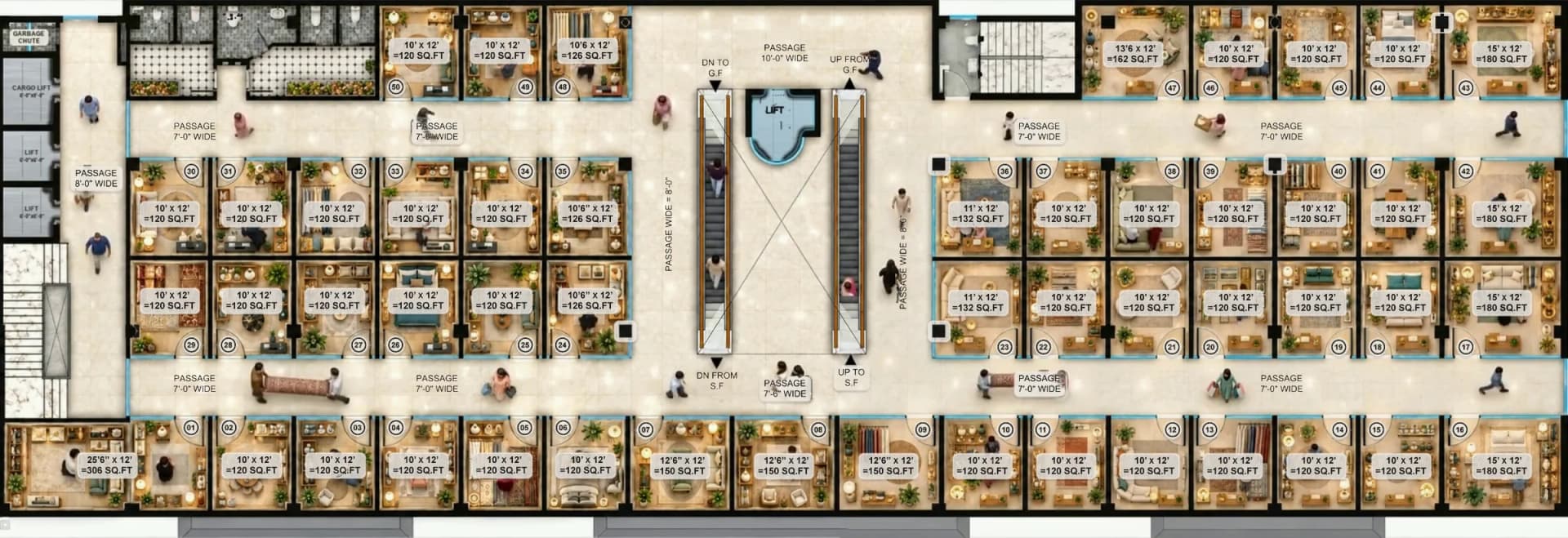
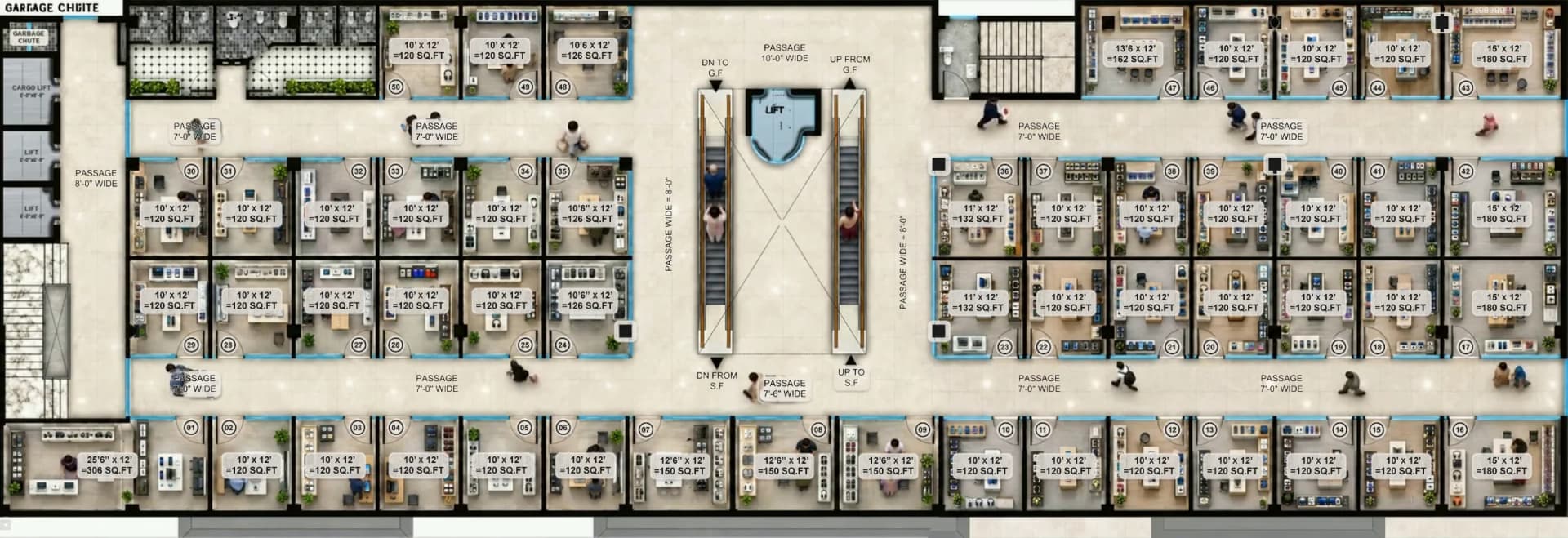
For your own business, start from the trade. The owner’s planned focus runs floor by floor: babies’ and kids’ products on the lower ground; ladies’ fashion, jewellery and cosmetics on the ground floor; home décor on the first; mobiles, laptops and gadgets on the second; restaurants and terrace dining on the 8th. These are the owner’s plan for each floor, not signed tenants, leases or a promise of footfall; ask at booking what they mean for your trade, including whether a different trade is acceptable on a given floor.
To let the unit out, the planned focus matters in a different way: a prospective tenant will ask the same questions, and a floor theme that narrows the list of likely tenants may lengthen the time it takes to let. Standard sizes are easier to compare and to market. On the sheet, the most repeated sizes are the lower-ground shops of 100–113 sq ft (Rs 40,00,000 to Rs 45,20,000), the 120 sq ft first- and second-floor shops (Rs 48,00,000 each) and the 7th-floor apartments of 450 and 650 sq ft (Rs 67,50,000 and Rs 97,50,000).
What will the unit cost me before it earns anything?
Either way, the unit costs money before it can be used. LG45 (100 sq ft) is Rs 40,00,000: Rs 12,00,000 down, then 24 instalments of Rs 1,00,000 each, and Rs 4,00,000 on possession. A 450 sq ft apartment such as 713 is Rs 67,50,000: Rs 20,25,000 down, 24 instalments of Rs 1,68,750 each and Rs 6,75,000 on possession. The instalment schedule is confirmed at booking.
Nothing can be earned or saved from the unit until possession, and no possession date is published. Plan to fund the whole schedule from your own resources, not from expected rent. Then add what the price does not include: fit-out, any service charges, utilities while the unit stands empty, and transfer or other fees. Ask the desk to confirm each in writing, and treat anything unconfirmed as a cost you still have to estimate.
How do I judge the rental case without a published rent?
Build it yourself, from sources you trust. Ask estate agents who are not selling China Center what comparable spaces in the Business District of Bahria Town Phase VIII let for, and how long they sit empty between tenants. Talk to the kind of business you would want as a tenant about what they need from a space. Treat every figure you hear as an estimate, and test your plan against a period with no tenant at all.
Then set those estimates against your full cost – the price, the fees, the charges and any fit-out you would provide – rather than the price alone. If the case works only on the most hopeful assumptions, it does not work. Anyone who promises you a fixed rent or a set income from a China Center unit is making a claim the developer’s documents do not support.
What does using the unit myself involve beyond the price?
Running your own business from a shop removes the tenant risk but adds operating ones. Cost your fit-out, stock, staff and utilities, and decide how long you can trade while customers discover a new building. Ask whether there are rules on signage, opening hours and which goods may be traded on each floor, and whether the rules differ between floors.
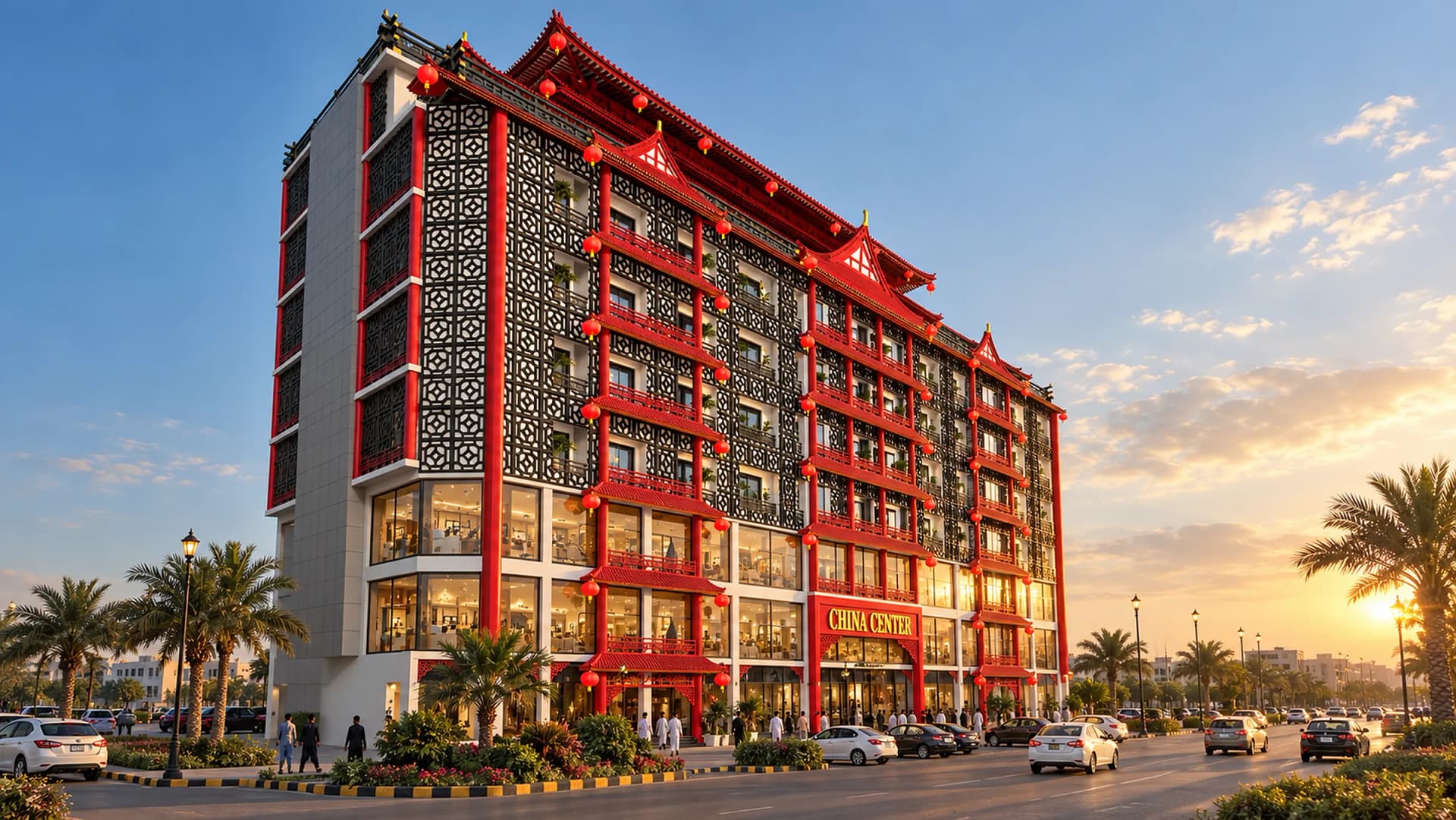
For an apartment, self-use is simpler: you are the resident. Ask about service charges, how residents’ access is kept separate from the shopping floors, and what finishes are included, since the images on the site are artist’s impressions. The guide for young professionals (/guides/apartments-for-young-professionals-bahria-town-phase-8) covers living at China Center in more detail.
Can I let a unit while living abroad?
Many overseas Pakistanis buy with letting in mind. If you will be away, decide before possession who will find tenants, draw up leases, collect rent and handle repairs, and how you will pay them. Put that arrangement in writing; a verbal promise from a relative or agent is hard to enforce from another country.
Ask a qualified tax adviser how rental income and property ownership are taxed in your case, both in Pakistan and where you live. The guide for overseas buyers (/guides/overseas-pakistanis-buying-process) covers booking and paying from abroad.
What should I decide before booking?
Settle these points on paper before choosing a unit code, so the unit fits the plan rather than the other way round.
Then WhatsApp Al Faisal Properties on +92 334 9107537 with the units you are weighing, ask for the official schedule for each, and book a site visit.
- Self-use, letting, or both at different times
- The trade or tenant you have in mind, and whether the floor’s planned focus fits it
- Whether you can fund the full schedule with no income from the unit
- Your costs beyond the price, confirmed in writing where the desk can confirm them
- Your own rental estimate from independent sources, tested against an empty period
- Who manages the unit if you are not there
Frequently asked
What rental income can a China Center shop earn?
None is published, and no one can promise one: there is no signed tenant and no trading history. Ask independent agents about comparable spaces nearby and test your plan against a period with no tenant.
Which China Center unit has the lowest ticket?
A 100 sq ft lower-ground shop such as LG45, at Rs 40,00,000 on the developer’s current inventory sheet: Rs 12,00,000 down, 24 instalments of Rs 1,00,000 and Rs 4,00,000 on possession, confirmed at booking.
Can I run my own business from a China Center shop?
Yes. Check how your trade fits the floor’s planned focus, which is the owner’s plan rather than a lease or a promise of footfall, and ask at booking what the focus means for your trade.
Is a shop or an apartment better for letting?
Neither is better in general. A shop depends on trade and the floor’s planned focus; an apartment on demand from residents. Compare the full cost of each against your own evidence of demand; this site publishes no rent or return for either.
More guides
Buying · 8 min read
The 30 / 24 / 10 payment plan explained, with worked examples
One plan covers every unit on the sheet. Here it is worked through for every listed size, with what the sheet does not say and how to pay safely.
Buying · 8 min read
Due-diligence checklist: the documents to ask for before booking
A document-by-document checklist for verifying China Center before you pay: what to ask for, why it matters, and how to cross-check it against the inventory sheet.
Buying · 8 min read
20 questions to ask before you book a unit at China Center
Twenty specific questions on price, payment, the unit, the building and your rights – and why each matters – to ask before you book at China Center.